


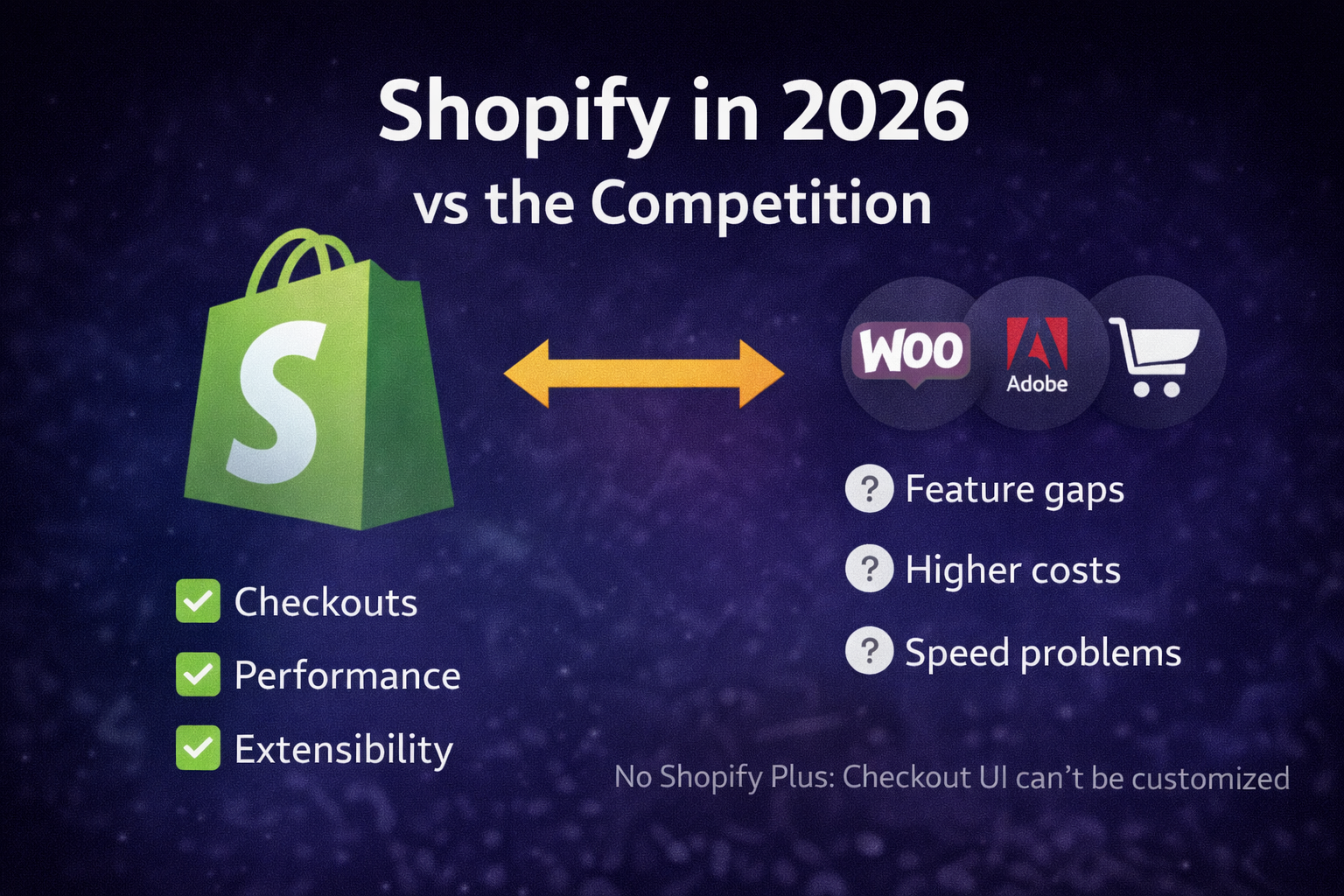
In 2026, Shopify is no longer “just a store builder.” It’s a commerce operating system: a hosted platform that combines storefront tooling, checkout, payments, global selling, and a large app ecosystem—while pushing more customization into upgrade-safe primitives like Extensions and Functions. Shopify’s Winter ’26 Editions highlights that Shopify Functions will replace Scripts in 2026, reinforcing the shift toward safer, more maintainable customization. Shopify Editions | Winter ’26
This article is a practical comparison of Shopify versus common alternatives—WooCommerce, BigCommerce, Adobe Commerce (Magento), and Salesforce Commerce Cloud—so you can pick the platform that matches your business model and your team’s reality.
If you’re evaluating Shopify for an international DTC brand, MoonImpact can help with Theme Development, Migrate to Shopify, and Shopify Plus Experts.
Shopify in 2026: the core value
1) A checkout that’s hard to beat
For most brands, checkout is where platforms truly differ. Shopify has invested heavily in fast, stable checkout and accelerated payments like Shop Pay. Shopify cites that Shop Pay can lift conversion by up to 50% compared to guest checkout. Shopify CRO statistics
Shopify’s direction is also clear: customize checkout through Extensions and Functions, aiming for upgrade safety. Checkout extensibility (Shopify) and Apps in checkout (Shopify.dev)
2) Global selling from one admin
International selling has become a default requirement. Shopify emphasizes tools like Managed Markets to sell across many countries from a single store and handle duties and customs workflows. International ecommerce (Shopify)
3) B2B capabilities (Plus-dependent)
Shopify also offers a native B2B suite—but the plan requirement matters. Shopify Help Center states that Shopify B2B is available only on the Shopify Plus plan. B2B features on Shopify (Help Center)
Where Shopify typically wins in 2026
- Speed to market: hosted infrastructure, predictable updates, and a clear theme architecture path.
- Conversion infrastructure: strong checkout and accelerated payment experiences like Shop Pay. Shopify CRO stats
- Global commerce tooling: Markets/Managed Markets workflow for cross-border selling. Shopify international ecommerce
- Extensibility with guardrails: extensions and functions intended to reduce maintenance risk over time. Winter ’26 Editions
Where alternatives can win (and when to consider them)
WooCommerce (WordPress)
WooCommerce is described as an open-source ecommerce platform for WordPress. It can be a strong fit for content-heavy businesses already invested in WordPress and willing to manage hosting, updates, plugins, and performance. WooCommerce plugin listing (WordPress.org)
When WooCommerce can win: maximum ownership and customization, deep WordPress editorial workflows, and teams that can handle ongoing maintenance.
BigCommerce
BigCommerce positions itself as an API-first platform with strong headless support and flexible architecture for custom experiences. BigCommerce headless commerce
When BigCommerce can win: some enterprise requirements, multi-storefront complexity, and teams that want SaaS but prefer BigCommerce’s ecosystem and architecture choices.
Adobe Commerce (Magento)
Adobe describes Magento Open Source as a free ecommerce platform that can be extended and tailored. Open-source commerce often implies a heavier lift: infrastructure, security patching, and ongoing development responsibility. Magento Open Source (Adobe)
When Adobe Commerce can win: complex enterprise commerce requirements and organizations committed to Adobe’s ecosystem and capable of supporting a more engineering-heavy stack.
Salesforce Commerce Cloud
Salesforce positions Commerce Cloud as an end-to-end platform for B2C and B2B digital commerce, typically aligned with larger organizations using Salesforce data and CRM workflows. Salesforce Commerce Cloud
When Salesforce can win: deep CRM-driven commerce and enterprise organizations standardizing on Salesforce across departments.
The 2026 decision framework: pick by constraints, not hype
Choose Shopify if you want
- Fast launch and predictable operations
- A top-tier checkout and accelerated payment options
- International selling tooling from one admin
- A theme system that your marketing team can operate
Choose Shopify Plus if you need
- Native Shopify B2B suite (Plus-only) Shopify B2B plan requirement
- More advanced checkout customization options through Shopify’s extensibility model (plan requirements depend on the checkout step and extension type) Checkout customization options
Choose open source if you accept
- Owning hosting, performance, and security work
- Higher technical overhead in exchange for freedom
How MoonImpact helps brands pick and build the right Shopify stack
MoonImpact builds Shopify storefronts as maintainable systems—theme architecture, custom sections, performance, and conversion-driven UX. If you’re moving platforms, we treat SEO as a first-class requirement from the start.
FAQ
Is Shopify good for international brands in 2026?
Yes. Shopify highlights tools like Managed Markets to sell across many countries and simplify duties, customs, and localization workflows. Shopify international ecommerce
Do you need Shopify Plus to succeed?
Not always. Many DTC brands thrive on standard plans. Shopify Plus becomes important when you need Plus-only capabilities like Shopify’s B2B suite or deeper checkout customization needs.
Is WooCommerce cheaper than Shopify?
WooCommerce can have lower software costs, but total cost depends on hosting, performance work, security updates, plugins, and development time. Shopify is hosted, which can reduce operational overhead for many teams.
What’s the biggest reason brands choose Shopify?
Operational simplicity plus conversion infrastructure. Shopify emphasizes checkout performance and Shop Pay, and positions its platform as a stable, upgrade-safe system built for modern commerce. Shop Pay conversion claim